The good luck charms Malaysia carries are not uniform. They come from three distinct cultural traditions, each with its own logic, its own proper use, and its own boundaries. This article introduces the six charms most commonly encountered in Malaysian homes, wallets, and places of business — what they mean, where they come from, and how to think about them if you choose to carry one.
Feng shui coins on red string
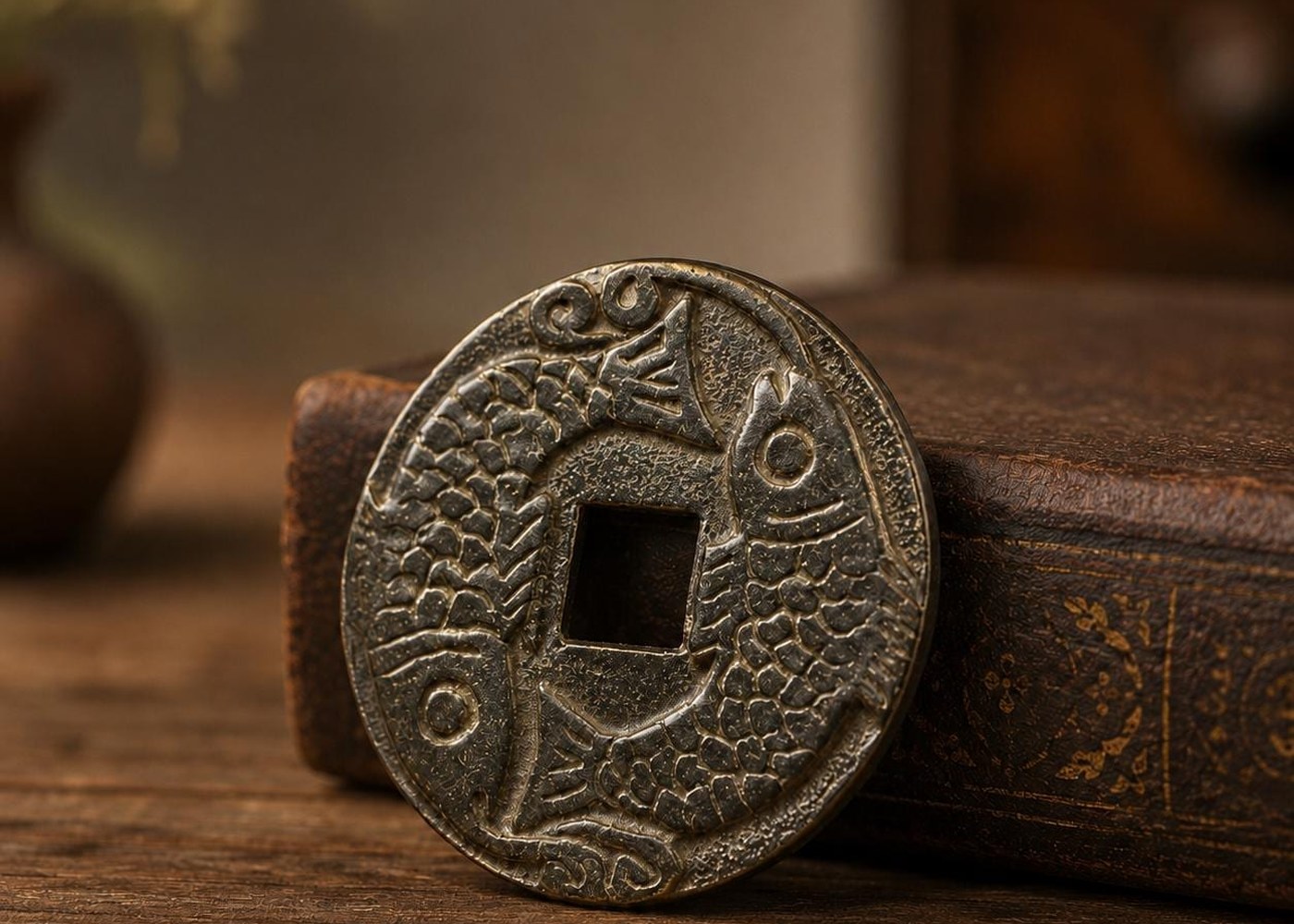
The single most carried good luck charm in Malaysia is the feng shui coin — a reproduction of the Qing dynasty square-hole coin, tied in threes or nines with red string. Carried in wallets, hung above cash registers, tucked into the lining of handbags. The square hole in the centre represents earth; the round rim represents heaven; the red string activates the binding between the two.
The number of coins matters. Three coins represent the three realms of heaven, earth, and humanity — the standard arrangement for personal use. Six coins represent heavenly blessings and are typically hung rather than carried. Nine coins represent completeness and are used for major undertakings — a new business, a house move, a long journey. Reproductions are widely available and inexpensive; antique coins exist but require authentication and are not meaningfully "more lucky" than a well-made reproduction.
The ang pow envelope
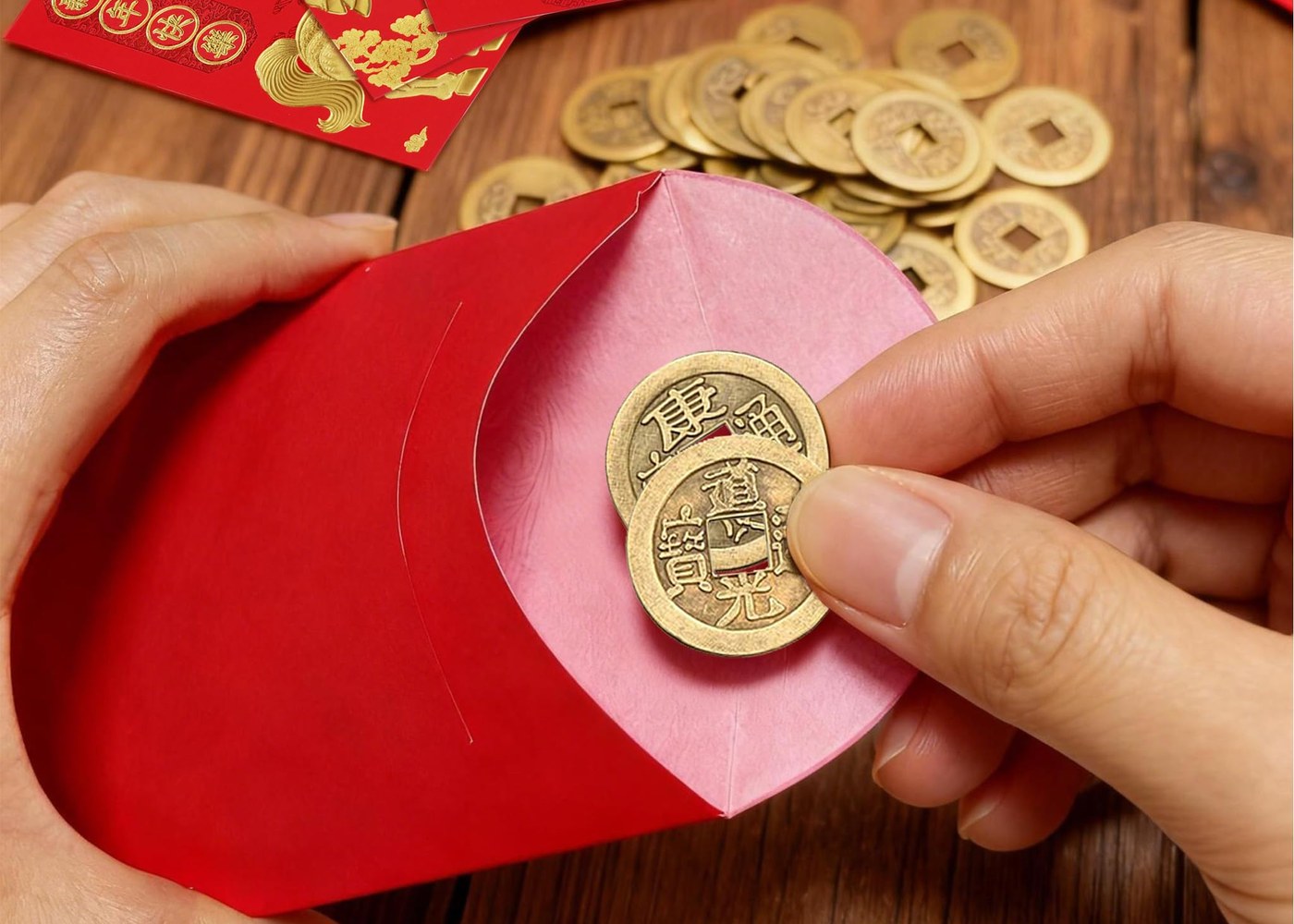
The ang pow — the red envelope used for cash gifts at Chinese New Year, weddings, and birthdays — is more than gift packaging. The red colour itself is the charm; it carries the protective energy of fire and life. This is why an ang pow is never given in white (the colour of mourning) or in black (the colour of misfortune).
Beyond its gifting role, the ang pow is sometimes carried in a wallet as a sealed container of intention. An empty ang pow, or one containing a small symbolic note, is kept through the year as a personal charm. The act of sealing the envelope is the act of sealing the intention — a small ritual that requires no specialist knowledge and no religious observance.
The Malay keris
The keris is the wavy Malay blade that serves simultaneously as a weapon, a spiritual object, and a family heirloom. A properly consecrated keris is a pusaka — an heirloom — passed through generations. It is kept in the home as a protective object, hung above doorways or displayed in a stand, and is believed to ward off burglary, illness, and interpersonal harm.
The spiritual dimension of the keris is real and should be approached with respect. Older Malay families will not move a keris without consulting an elder, and a keris is never displayed casually. If you acquire one — by inheritance or through a reputable dealer — treat it as an object with a lineage. The blade carries the family's history; it is not a decorative item.
Reproductions of the keris, marketed as decorative objects, are widely sold to tourists. These are not consecrated objects and should not be treated as such. They are aesthetically meaningful but spiritually inert. The distinction matters; treating a reproduction as a consecrated blade is, at best, cultural confusion.
The Hindu yantra
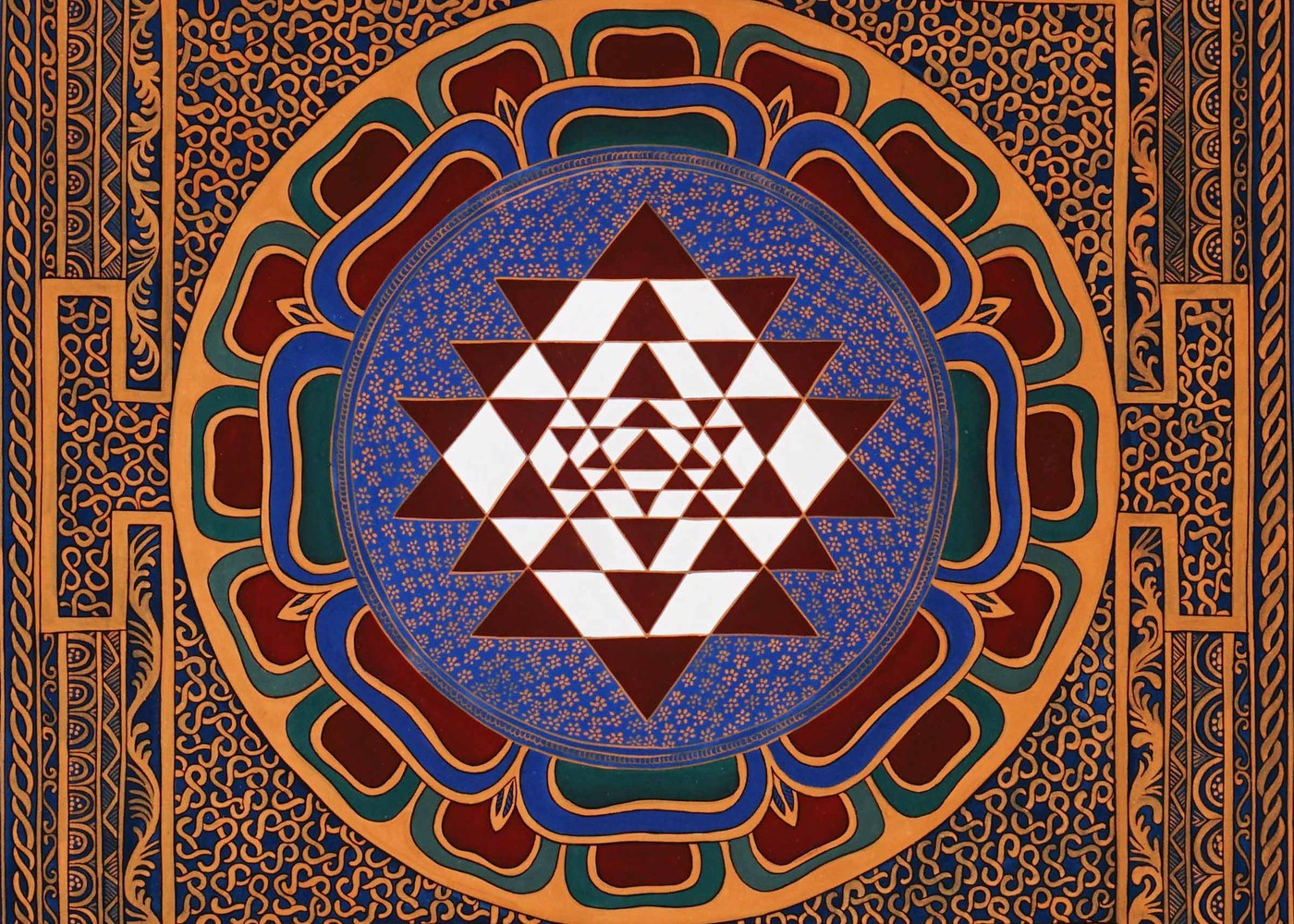
A yantra is a geometric diagram used as a focal point for meditation and as a protective charm in Hindu and Tantric traditions. The Sri Yantra — a complex interlocking of nine triangles surrounding a central point (bindu) — is the most widely recognised and is kept in prayer rooms, business premises, and occasionally in wallets as a small copper plate.
Each yantra is associated with a specific deity and a specific intent. The Sri Yantra is associated with abundance and is the most commonly encountered in Malaysian Indian homes. The Mahalakshmi Yantra is associated specifically with wealth. The Kuber Yantra is associated with the god of treasure and is kept in places of business.
A yantra is not a decorative symbol; it is a focus for meditation. To use one properly is to sit with it regularly, allowing the geometric pattern to draw the mind inward. Displayed without use, it functions as a reminder of intent; used with meditation, it functions as a tool of practice.
The Tamil kaval
The kaval is the South Indian Tamil equivalent of the Malay tangkal — a small protective amulet, traditionally a copper or silver tube containing a folded paper inscribed with deity symbols and a short verse. Worn on a black string around the upper arm or neck, the kaval is most often given by a family elder or a temple priest after a brief consecration.
In Malaysian Tamil households, the kaval is most often given to children, to those starting a new job, or to those who do night shifts. The protective intent is specific — safety during vulnerable times — rather than general fortune. The practice is modest and unobtrusive; the kaval is worn under clothing and rarely discussed outside the family.
The maneki neko (cross-cultural)
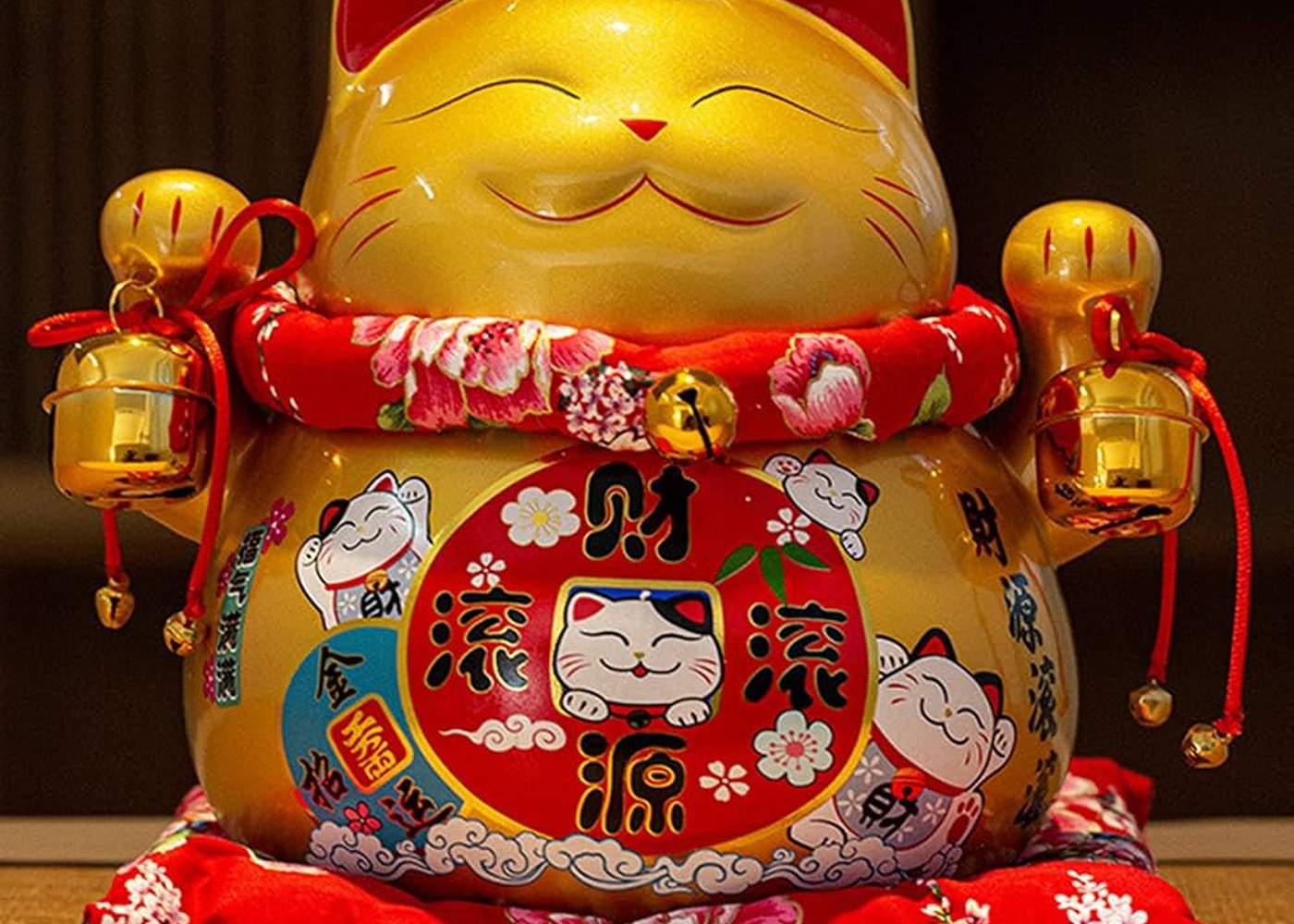
The maneki neko — the Japanese lucky cat with one raised paw — is, strictly speaking, neither Chinese, Malay, nor Indian. It has, however, been adopted widely by Malaysian Chinese businesses and betting outlets, and is now a fixture of the Malaysian commercial landscape.
A raised left paw is said to invite customers; a raised right paw is said to invite money. Many outlets display both. The colour also carries meaning: white for purity, gold for wealth, black for protection against stalkers (an interpretation more common in Japan than in Malaysia), and calico for the traditional combination of all three.
The maneki neko's popularity in Malaysia is a useful reminder that the country's good luck charm vocabulary is not closed. Charms travel. Practices cross community lines. What looks traditional may have been adopted within living memory, and what looks imported may, over time, become local.
Owning a charm responsibly
Three principles, drawn from the elders and practitioners we spoke with, govern the responsible ownership of a good luck charm in Malaysia.
First, know the origin. A feng shui coin is a Chinese object with a specific cultural logic; a keris is a Malay object with a different logic; a yantra is a Hindu object with another. Carrying an object without understanding its origin is, at best, decoration. Carrying it with understanding is participation in a tradition.
Second, do not mix traditions carelessly. A feng shui coin in the same wallet as a tangkal prepared by a bomoh is not twice as lucky; it is more often a sign that the carrier has not committed to either tradition. Where charms from different traditions are carried together, it is usually because the carrier has a genuine relationship with both communities — a Chinese-Malay family, an Indian-Chinese household. In those cases the mixing is authentic. In other cases, it is not.
Third, do not use a charm to enable behaviour the charm cannot justify. A good luck charm in a wallet does not make gambling safer. A protective amulet does not make reckless driving acceptable. The charm is a piece of meaning; it is not a substitute for judgement. Held in that frame, it enriches daily life. Held in any other frame, it becomes a rationalisation.
If your relationship with gambling has become a concern rather than a curiosity, the Malaysian National Council on Problem Gambling can be reached at 03-2789 5144. The line is free, confidential, and operated by trained counsellors. The charms described in this article are cultural; they are not, and were never meant to be, a defence against the mathematics of chance.